Your first time on the rock: climbing at Pecka
What to expect if you have never climbed, and why it is nowhere near as alarming as it sounds.
 Visitor centar Pecka
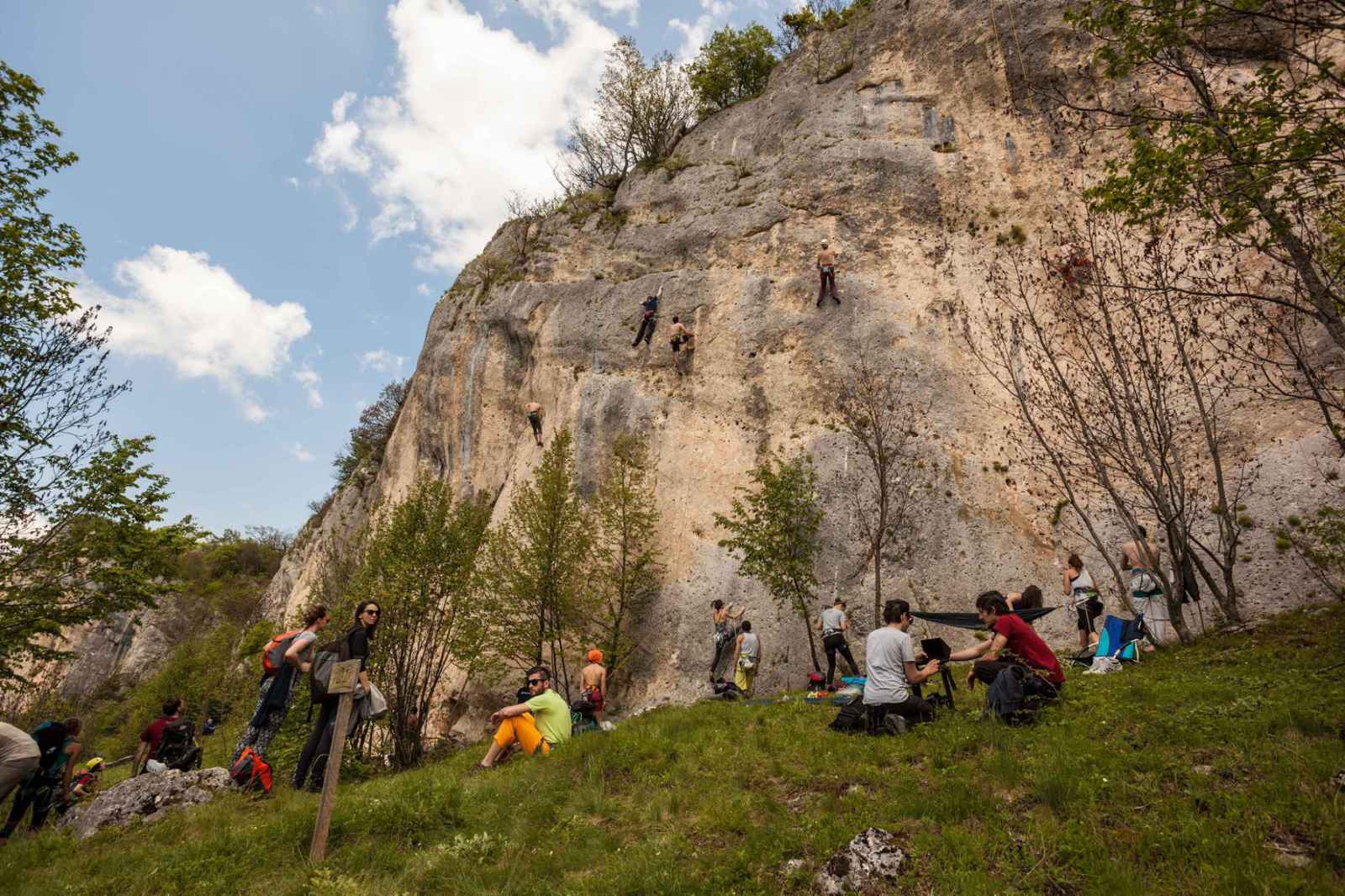
The first thing people picture when they hear "climbing" is the wrong thing. They imagine someone hanging bare handed over a drop, no rope, wondering how much life is left in them. That isn't this. Almost nowhere is that this. Sport climbing, the kind you climb at Pecka, was invented precisely to take the danger out of the way and leave only the good part: a problem you solve with hands and feet, move by move, while you're safe the whole time.
Here's how it works in practice. The rock is equipped. Fixed anchor points are already set into it, and as you climb you clip your rope through them. The other end of that rope is held by a person on the ground, your partner, whose job is to keep the rope taut. That means something very concrete: if your hand slips or your strength gives out, you don't fall. You stop at once, hang on the rope, catch your breath, and carry on. The first time it happens, the first time you let go on purpose and feel the rope actually hold you, most of the fear goes. The body finally believes what the head already knew.
Pecka is an unusually good place to start. Above the village rises one of the largest and best known climbing areas in Bosnia and Herzegovina, with more than one hundred and forty routes of varying difficulty. That word, varying, is the key one. Not all of it is for the experienced. There are gentle routes, almost like a steep ladder, just right for hands and feet learning for the first time what's being asked of them. Everyone starts on those easy lines, children and older people alike, and no one is embarrassed by it.
If you want to feel what it's like before going up at all, you don't have to start at height. At the center itself there's a bouldering rock, a low wall you climb without a rope, just above the ground. Half an hour of playing on it convinces you of the very thing you were most worried about: that your fingers hold you, that your legs do more of the work than you thought, and that climbing isn't a matter of raw strength at all but of calm and thinking. The best climbers aren't the strongest, they're the ones who work out most calmly where to put a foot next.
What do you actually need the first time? Less than you think. Comfortable clothes you can bend and lift a knee to your chest in, and the willingness to try. Everything else, rope, harness, helmet and climbing shoes, is gear you don't improvise and that you need someone who knows to handle. That's why a first outing is done with a guide, not on your own. The guide is there both for safety and to show you exactly the routes meant for your first day, rather than the ones that would put you off. The simplest thing is to contact the center in advance and arrange a time.
That leaves the question of fear, which no one admits to and everyone has. The truth is simple. Fear at the start is almost entirely in your head, in that picture from the beginning that has nothing to do with this. Once you see the rope, see the person belaying you, and stand a metre off the ground for the first time and realise you're completely fine, the fear shrinks to a reasonable size. What's left isn't fear but focus, and that feeling, when your whole world narrows to the next hold, is what many people describe as the reason they came back.
And then comes the top. It doesn't have to be high. A first top is usually low, and that's fine. What matters is that you turn around and look down, at the meadows and the village roofs, and it dawns on you that a moment ago you thought you couldn't. That's the whole point. Not the rock, but the moment it turns out you could.