How an old school and a wild river brought a Bosnian village back to life
People have been stopping to rest in Pecka for almost two thousand years. Historical sources place the Roman way station of Sarnade here, a resting point on the road that ran from Salona on the Adriatic coast (near today's Split) north to Servitium on the Sava River. A Roman traveller wanted what today's traveller wants: clean water, shade, a hot meal and someone at the door to welcome them. We are the Greenways Association, and for more than ten years we have been working to make Pecka that kind of place again.
2,000 years ago
Sarnade, a Roman way station on the road from Salona to Servitium
Who we are
Greenways is a non-profit association founded in 2007 in Bosnia and Herzegovina. We protect nature and help rural communities thrive through sustainable tourism, education and local enterprise. Our home is Gornja Pecka, a village in the municipality of Mrkonjić Grad in western Bosnia, about 80 km southwest of Banja Luka and roughly 170 km from both Sarajevo and Split. The springs of the Sana River are six kilometres up the valley. Here we run the Pecka Visitor Centre, a meeting point for climbers, cyclists, hikers, mushroom hunters, school groups, volunteers from around the world and neighbours who drop by for coffee.
Nature is not an obstacle to development. It is the greatest asset a rural community has.
One simple belief guides us: nature is not an obstacle to development, it is the greatest asset a rural community has. A clean river, a healthy forest and a living village are worth more than anything that could be built in their place. We did not learn this from a textbook. We learned it the hard way.
It started with a fight for a river
In 2009, plans emerged for a small hydropower plant at the very start of the Sana, right where the river bursts out of the limestone. More than twenty organisations and citizen groups from the Sana basin joined forces in a coalition to defend it. Years of court cases, protests, petitions and online campaigns followed.
We did not win everything. The plant was eventually built, but further from the springs than originally planned, and a process to protect the springs permanently was set in motion. It took more than a decade of persistence. On 1 October 2021, the springs were declared the Sana Springs Natural Monument (Vrela Sane). The protected area covers 320.69 hectares, including three karst springs, the lower course of the Korana stream and Mračaj, a rare karst feature that works as a spring or a sinkhole depending on the groundwater, and a magnet for cave divers.
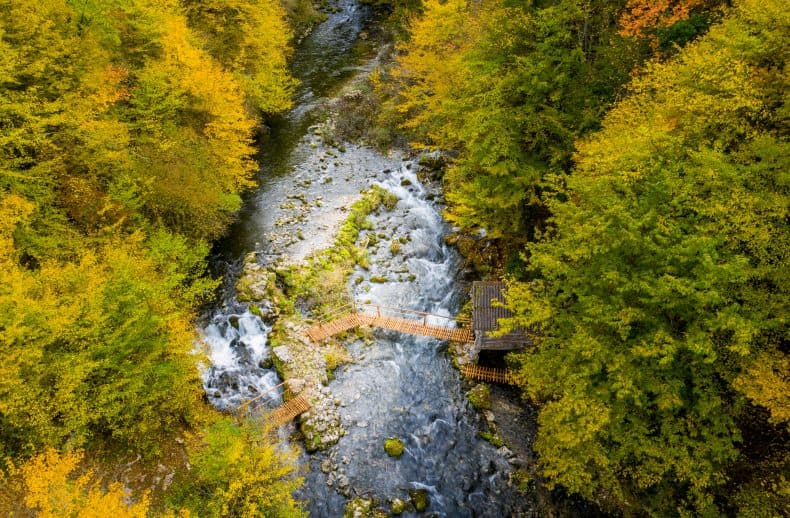
· years of persistence
Saying “no” is not enough.
That fight taught us the most important lesson of our work: saying “no” is not enough. If we want a river to stay clean, the people who live beside it need to be able to make a living from it, not from destroying it. So today we show, in practice, that protected nature can bring jobs, income and new people to the countryside.
The school that was briefly a bar
The first plan was to build a visitor centre on Mount Lisina. The project got stuck in paperwork, and that might have been the end of the story. Then Milan Blagojević, an architect who prefers to call himself a builder, came across an abandoned building in Gornja Pecka.
It was the village primary school, opened in 1931. Generations of local children learned to read and write there until 1985, when there were simply not enough children left. The building did not stay empty for long: for a few years it became a village bar, the kafana “Korana”. Some would say it was still a school of sorts, just with a different curriculum. Eventually that fell quiet too.
What had stalled on Lisina moved quickly in Pecka. The permit came through surprisingly easily, and within a few months Milan had turned the neglected school into the space guests know today. Greenways settled in Pecka in 2014, and the Pecka Visitor Centre opened its doors in 2015.
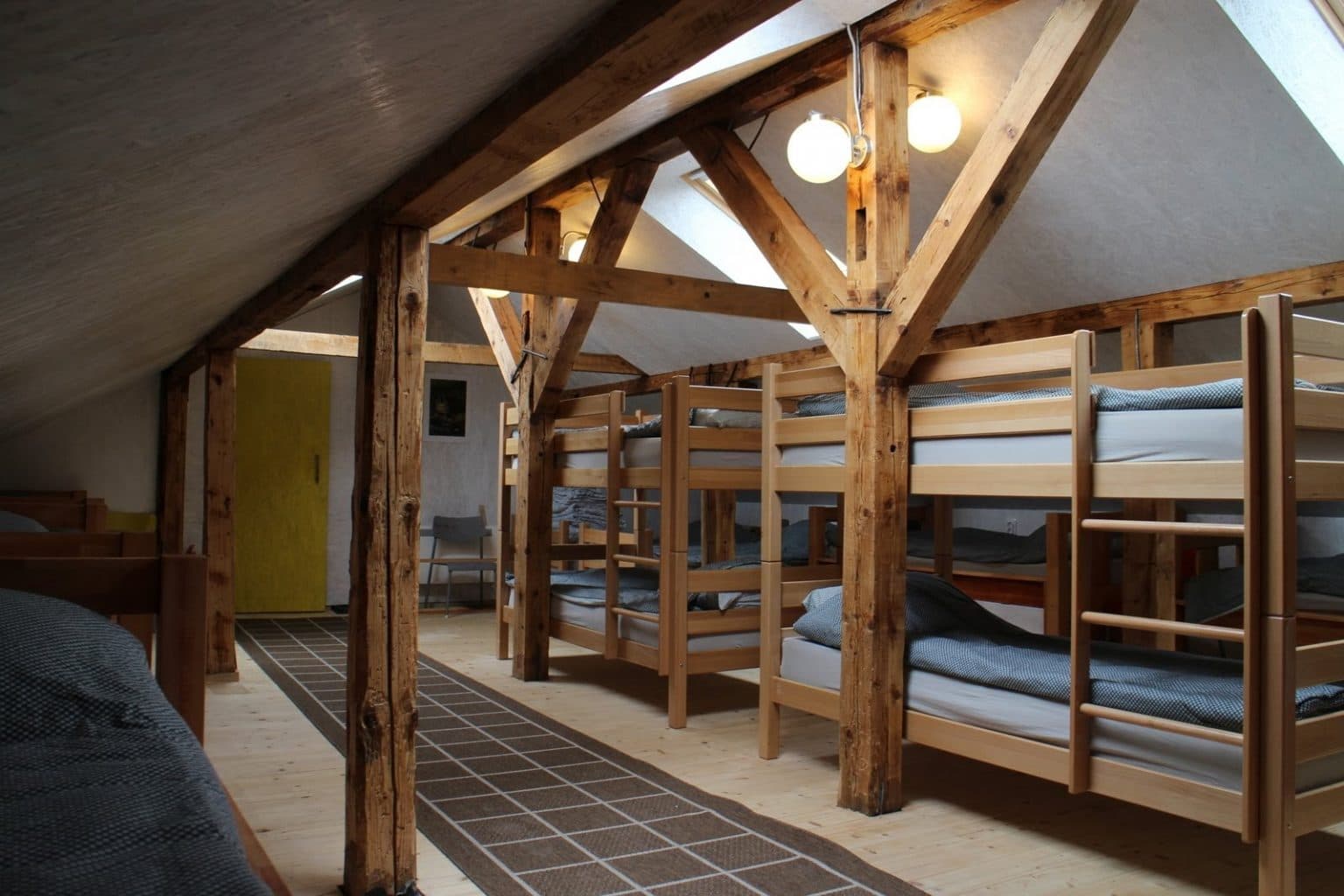
Today the old school is a place to sleep, eat, learn and plan. The attic is now a shared dormitory that, to many guests' surprise, stays warm even in the middle of winter. Cheese, eggs, honey and rakija (the local fruit brandy) come from our neighbours, and village women bake the traditional pies. If you hear about “forest chicken” in Pecka, rest assured no chicken was harmed: it is a mushroom, and you can learn all about it at our Mushroom School.
Forest chicken?
Laetiporus sulphureus, a mushroom that grows on trees
“A visitor centre is not an island, living here only for itself and off itself. It had to be shaped so that it benefits the people who live here, and those who are yet to come.”
“It was never our goal to be caterers. Our mission is to develop rural tourism.”
The city man who stayed
Boro came to Pecka from the city. Asked how he adapted to village life so easily, he answered in his own style.
“I lived in the city for a long time, that's why I got used to the village so easily.”
Not everyone believed he would last. One neighbour later admitted to journalists that he had hoped Boro would stay as long as possible, but never believed anyone could be that persistent. Boro stayed. He bought land, registered as a resident and today, in his own words, he knows everyone and everyone knows him. The same neighbour now says the village would surely have died without him.
Sunshine on the school roof
In 2019 we launched the “Solarna Pecka” (Solar Pecka) crowdfunding campaign together with the Centre for Environment in Banja Luka. The idea was simple: instead of watching the electricity bill grow every season, let the sun power the centre. The campaign was backed by 226 citizens, organisations and companies, and UNDP matched the amount raised. Today the school roof carries solar panels and solar water heaters, and the centre and its facilities run on renewable energy. It was one of the first community-funded solar plants in rural Bosnia and Herzegovina, and proof that people are ready to invest in a cleaner future when they are given the chance.
0
citizens, organisations and companies
One cell on the roof, one backer of the campaign.
How Pecka has changed
2,500
Around 2,500 residents
When we arrived, Pecka was a village slowly fading away. From around 2,500 residents in its heyday, only about a hundred remained, most of them elderly. Many had left for the cities, many for Vojvodina in northern Serbia, leaving their houses to weeds and stone.
Ten years later the picture is different. More than eighty houses in the village have been renovated or built. The municipality of Mrkonjić Grad paved the road and upgraded the power grid. Village households now host guests, the cliffs above the village hold more than 120 sport climbing routes, and hiking and mountain bike trails wind through the surrounding forests and meadows. Every summer the Pecka Outdoor Festival brings thousands of people to a village that not long ago was home to barely a hundred people. Pecka has been named one of the 14 Most Beautiful Villages of Bosnia and Herzegovina and featured among the Green Destinations Top 100 Stories of sustainable destinations worldwide.
Those who left are coming back too, at least for the summer. Olympic water polo champions Gojko and Duško Pijetlović, whose father Jovo left Pecka for Vojvodina in 1977, happily spend their holidays in their parents' village.
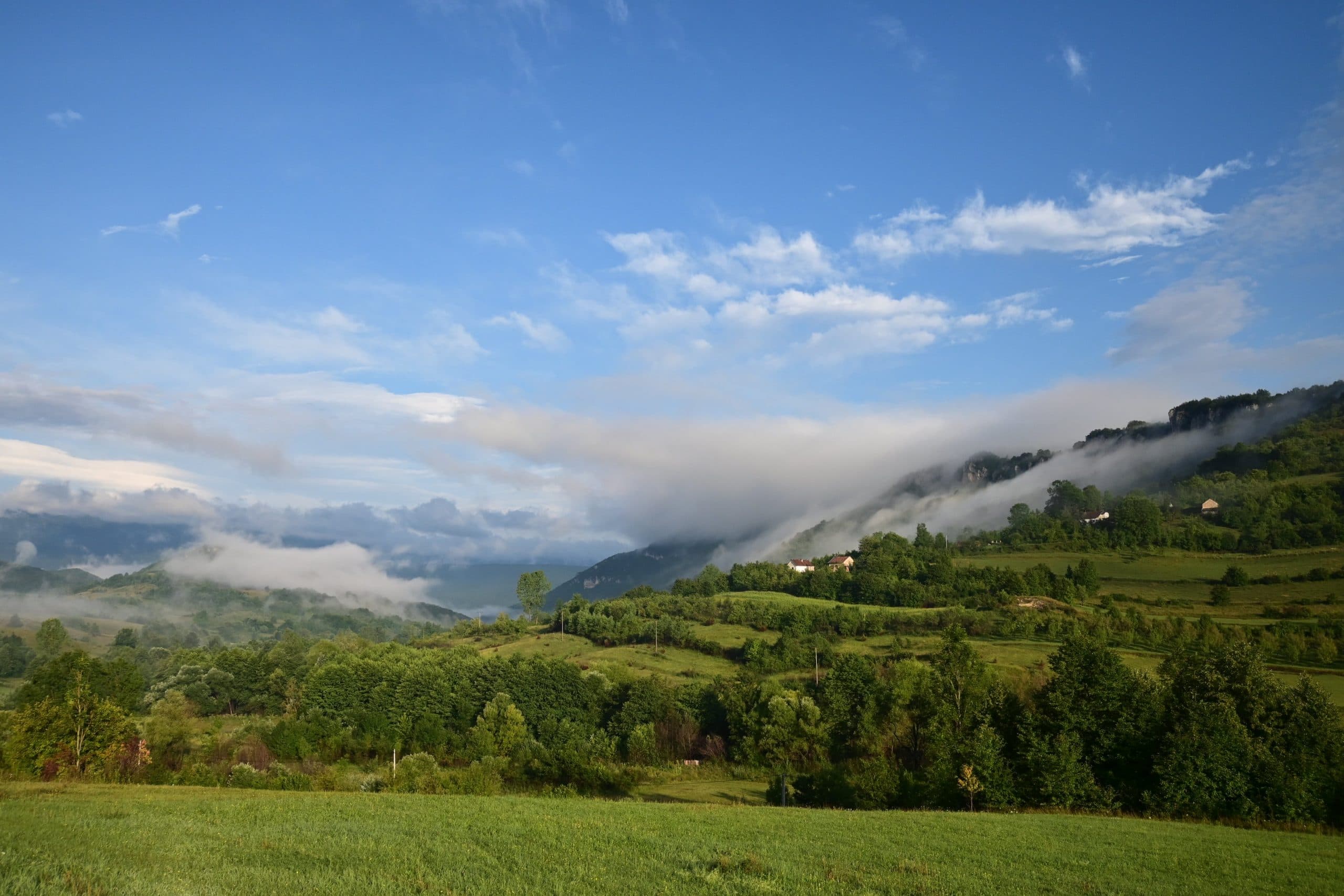
Paradise on earth
Duško Pijetlović
“It's cheaper here than Ibiza.”
Gojko Pijetlović
How we work
Together with the public forestry companies of Mrkonjić Grad and Ribnik, we help manage the Sana Springs Natural Monument, taking care of visitor access, trails, infrastructure and promotion. We are also campaigning for protected status for Vitorog Mountain and the source of the Pliva River.
We work with local producers and help them sell directly, with no middlemen. That is how the Šarena pijaca (Colourful Market) was born at the festival, and how Komšiluk, our catalogue of neighbourhood producers on this site, came to be. The Greenways Managing Board and Assembly are both chaired by women, and we give special support to women who keep traditional cooking and crafts alive. For young people we offer training, volunteer programmes and jobs in tourism and conservation, and through Workaway we host volunteers from all over the world.
We partner with municipalities, universities, schools, fellow NGOs, UNDP and the private sector, and we are part of the Dinardica initiative and the Via Dinarica network, the long-distance trail along the Dinaric Alps. Through these partnerships, more than one million euros has been invested in the village, renewable energy and tourism infrastructure.
What we do
- Nature protection
- We help manage the Sana Springs Natural Monument and campaign to protect Vitorog Mountain and the Pliva River source.
- Sustainable tourism
- Climbing, cycling, hiking and a festival that bring people to the village without paving it over.
- Education
- Mushroom school, programmes for schools and universities, workshops and volunteer camps.
- Renewable energy
- Solar Pecka: an old school roof that makes its own electricity, thanks to 226 donors.
- Community development
- Local producers, host families and real jobs for young people in the countryside.
What we hold to
- Nature
Rivers and forests are not resources to use up. They are the reason people come.
- Community
The centre is not an island. Every guest should benefit the neighbours too.
- Knowledge
We learn from the village elders and pass that knowledge on to young people.
- Partnership
We work with municipalities, universities, NGOs and responsible businesses.
- Sustainability
We work so that in thirty years Pecka still has clean water and living people.
Why we do it
Because we believe the countryside is not the past, it is an opportunity. We are not just building a tourist destination. We are building a place where nature, people and the local economy can thrive together, and where one day a child might enrol in a school in Pecka again.
Come and see it for yourself. Plan your visit, spend a night in the old school and try the forest chicken. We promise, even then, no chicken will be harmed.
The Pecka school register
| Year | Entry |
|---|---|
| 1931 | The school opens. Generations learn to read and write. |
| 1985 | Too few children. The last school day. |
| 2007 | The Greenways Association is founded. |
| 2015 | Pecka Visitor Centre opens in the same building. |
| 2019 | Solar Pecka: 226 donors, sunshine on the roof. |
| 2021 | Sana springs protected: 320 ha, a natural monument. |
| today | 80+ houses renovated or built. One of the 14 most beautiful villages in BiH. |
| 20__ | The first pupil enrols |
Questions people ask
Who runs the Pecka Visitor Centre?
The Pecka Visitor Centre is run by the Greenways Association, a non-profit founded in 2007 and based in Gornja Pecka, in the municipality of Mrkonjić Grad, western Bosnia and Herzegovina.
Where is Pecka and how do I get there?
Pecka is a village in western Bosnia, about 80 km southwest of Banja Luka and roughly 170 km from both Sarajevo and Split (Croatia). The nearest towns are Mrkonjić Grad, Šipovo and Jajce.
How far is the visitor centre from the Sana River springs?
About six kilometres. The springs have been protected as the Sana Springs Natural Monument (Vrela Sane) since 2021.
Can I volunteer in Pecka?
Yes. Greenways hosts local and international volunteers, including through Workaway. Get in touch via our Contact page.