brews
VarcarThe beer that carries the town's name
Jugoslav Župić, Mrkonjić Grad
There is something honest about a beer that hides nothing. Varcar is the craft beer Jugoslav Župić brews in Mrkonjić Grad — homemade, cloudy, unfiltered and unpasteurised, the way beer can be when it is made with time and restraint rather than on a line. Nothing is combed out of it so it will sit longer on a shelf; what is in the glass was in the cask.
A beer for people who like to know where their glass comes from — and that a person, not a factory, stands behind it.
1924
Varcar Vakuf
Mrkonjić Grad
The name: Varcar Vakuf
The name is already a story. Varcar is the old name of Mrkonjić Grad — the town was Varcar Vakuf until 1924, when it was renamed after King Petar I, who used the nom de guerre Mrkonjić in the uprising against the Ottomans. Naming a beer Varcar ties it to what came before — to an identity many no longer remember the town by.
The name lives in literature too: Branko Ćopić, one of the region's most beloved writers, left behind a story called „Varcar-Mrkonjić“. So every bottle, whether it means to or not, carries a piece of local history.
A name that obliges
Here, Varcar was never just geography — for centuries it was a mark of mastery.
The kosa varcarka — forged in Varcar Vakuf since the 16th century.
Varcar Vakuf, today's Mrkonjić Grad, was made famous by the kosa varcarka — a sharp, almost unbreakable scythe forged by local blacksmiths, the Zonić family among them, from the 16th century onward. It was the best-known scythe in the whole of the former Yugoslavia and beyond; the story goes that the most powerful people in the world owned one. The town's name travelled the world on the strength of what local hands made.
To name a beer Varcar is to step into that line. It is a name that obliges: whatever carries it has to be made properly, without shortcuts, built to last — like the scythe that would not break. Jugoslav's beer takes that seriously.
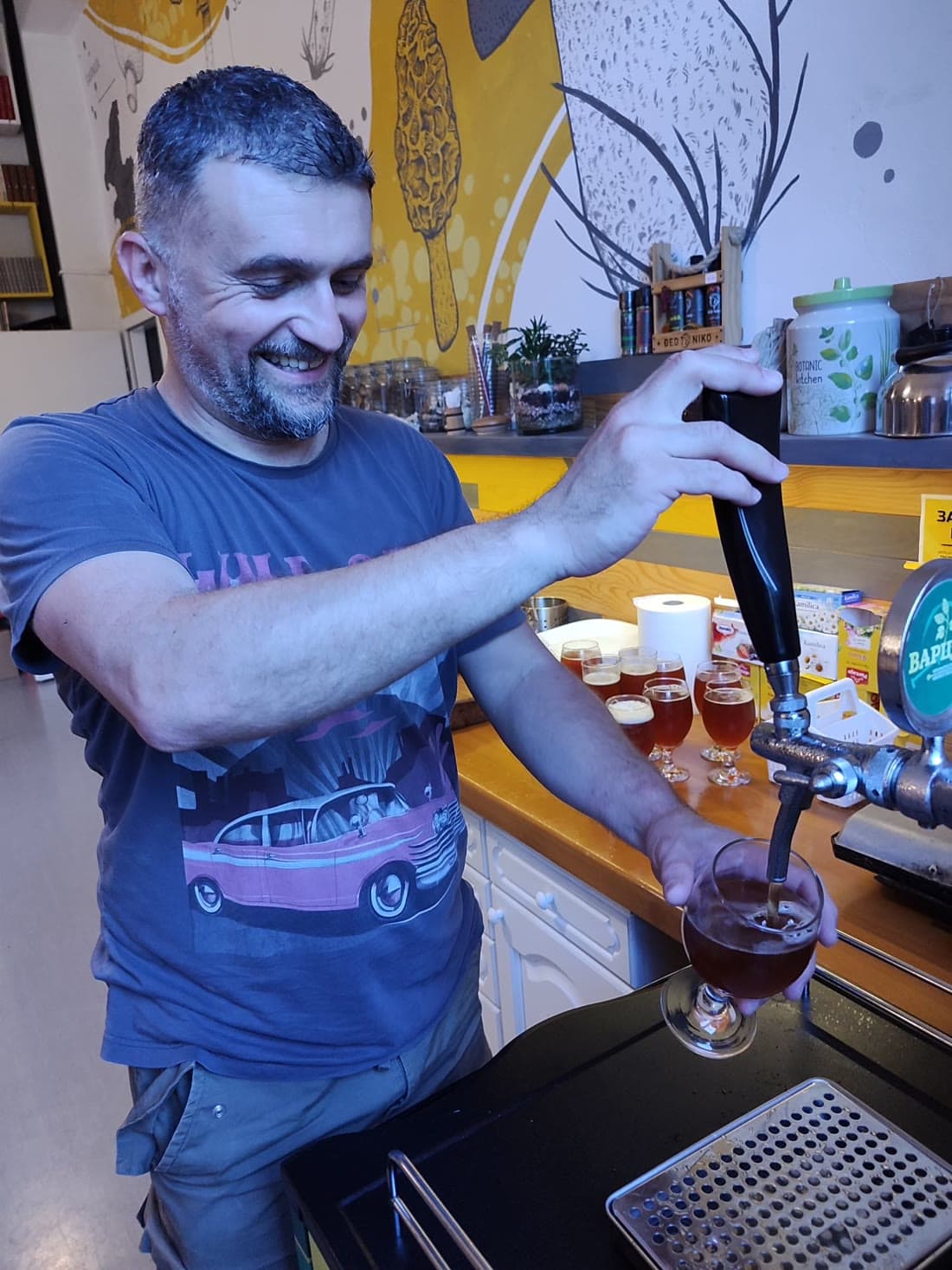
Here I am my own man.
A lawyer until noon, a brewer after it
Jugoslav has two jobs. One is his profession and his salary, the other is his love — and the second only starts when the first finishes. He is also a husband and a father of three.
Out of that comes the one message he keeps repeating: this corner of the country can offer a life with dignity. All that is missing is for people to believe it.
How it started
The end of 2015 and the start of 2016. He liked beer, discovered craft beer, and wanted a change. He puts it most briefly himself: he does not want to look back one day and see only ten ring binders.
He likes to cook too, so the idea of brewing something of his own took a while to ripen — until a friend mentioned a Belgrade pub that makes its own beer. The first six months were pure kitchen-table work: pots, coolers and tools he put together himself, the knowledge off the internet, and the vocabulary picked up along the way.
He started with a stronger dark beer from black barley, then moved to a lighter, mildly bitter version, following the taste of the people drinking it. The work is never finished — he says there is endless room to get better.
How Varcar is made
The recipe is settled now, but nothing in it goes quickly.
- 3
- kinds of barley
- 4
- kinds of hops
- 6.8%
- alcohol
Water, 24 hours ahead
Before anything else the water is prepared: dechlorinated, and its calcium brought down. Without that there is no beer.
Brew day
The working day starts around three in the morning and runs into the afternoon. Three kinds of barley, four kinds of hops and a top-fermenting yeast. German hops carry the bitterness, and the finish is Mosaic, with grapefruit and elderflower on the nose.
Maturing, 30 to 40 days
Brewing is one day; everything after it is waiting. Less is brewed in winter, more in summer.
No filter, no pasteurisation
The beer stays alive: a high concentration of yeast and B vitamins, and not a single additive.
Ours, authentic, homemade — and our own water.
The people behind the beer
None of this would stand up without his wife, who holds the whole household together while he brews. In the brewery he is helped by Aleksandar Vukoman, known to everyone as Sova.
The children are still small and nobody is pushing them to carry it on. What matters, he says, is that they recognise themselves.
The beers
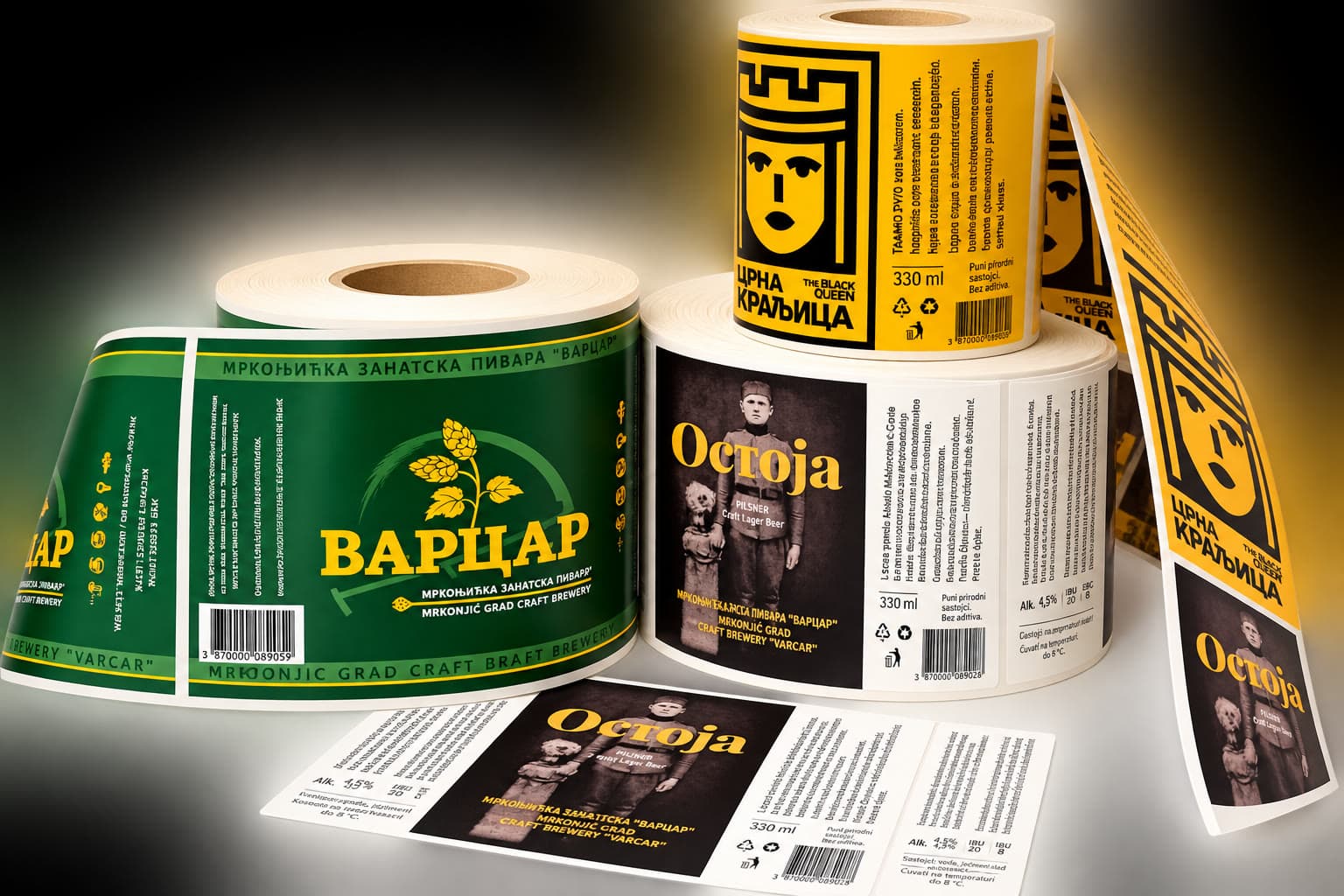
Varcar is not one beer — the Varcar craft brewery of Mrkonjić Grad tells several stories across its labels.
Varcar
American pale ale (APA) · around 6.8%
The flagship. Homemade, cloudy, unfiltered and unpasteurised. The haze and the sediment are a signature, not a flaw — proof the beer has not been through filters and pasteurisation for the sake of the shelf. A full, characterful beer, like the country it comes from.
Ostoja
lager · 4.5%
A lager for people who do not make easy compromises. Its label carries Ostoja Župić (1909–1941), photographed at the Sisak barracks in 1928, in the days of the Kingdom of Serbs, Croats and Slovenes. A beer dedicated to an ancestor and to a code: do it properly, no shortcuts. A rare beer that wears family history on the label.
Crna kraljica
stout
The brewery's special card: a stout made with blackthorn (sloes) picked in the canyon of the river Sana. A wild, local ingredient from the very canyon that is protected nature today — a beer that literally tastes of the place. It is named for the Black Queen, and a menu built around it ran in neighbouring Ribnik.
The Korana canyon
Why Varcar is different
Unfiltered and unpasteurised
Nothing is stripped out to make the beer last longer; the taste stays alive.
Small batches
Brewed as much as it takes to be good, not as much as it takes to fill a shelf.
Local, wild ingredients
Blackthorn from the Sana canyon — the country in the glass, not an import.
A story on every label
The town's name, an ancestor, the canyon — a beer you drink and read.
Where to taste Varcar
You can taste and buy Varcar at Visitor Center Pecka year-round, and in summer at the Šareni market during the Pecka Outdoor Festival. Perfect with local goat cheese and the rest of the neighbourhood — the whole of Pecka on one table.
Frequently asked questions
Who makes Varcar beer?
Jugoslav Župić, at his small craft brewery in Mrkonjić Grad.
Where does the name Varcar come from?
From Varcar Vakuf, the old name of Mrkonjić Grad, renamed in 1924.
What kind of beer is Varcar?
A craft American pale ale, around 6.8%, homemade, cloudy, unfiltered and unpasteurised — full and characterful.
What other beers does the brewery make?
Alongside Varcar there is Ostoja, a 4.5% lager with family history on the label, and Crna kraljica, a stout with blackthorn from the Sana canyon.
Where can I taste Varcar?
At Visitor Center Pecka, and at the Šareni market during the festival.
Jugoslav's story is retold from: Jugoslav Župić's interview with eTrafika — text and photographs: Njegoš Tomić, 20 January 2024